|
|
Modern states /
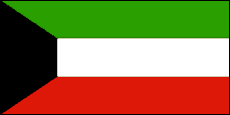
Kuwait
State of Kuwait
Arabic: dawlatu l-kuwayt 
Independent monarchy in Asia with 2.69 million inhabitants (2009 estimate) and an area of 17,820 kmē. The capital is Kuwait, also the centre of the wider urban area where practically all Kuwaitis live.
Administratively is Kuwait divided into 5 governorates, called muhafaza.
Day of independence is June 19, 1961, when governance was peacefully transferred from the British to the long-time ruler of Kuwait. The National holiday is, however, not this day, but February 25, 1950.
Head of state is Emir Sabah 3. Prime minister is Nasser Muhammad Al-Ahmad As-Sabah. There are 14 ministries, and 7 ministers come from the Sabah clan.
Kuwait's National Assembly is called Majlis al-Umma, and has 50 seats, but exercises limited power over national politics.
 Political situation Political situation
Geography
Water surface: 0 km²
Population density: 154 inhabitants per kmē.
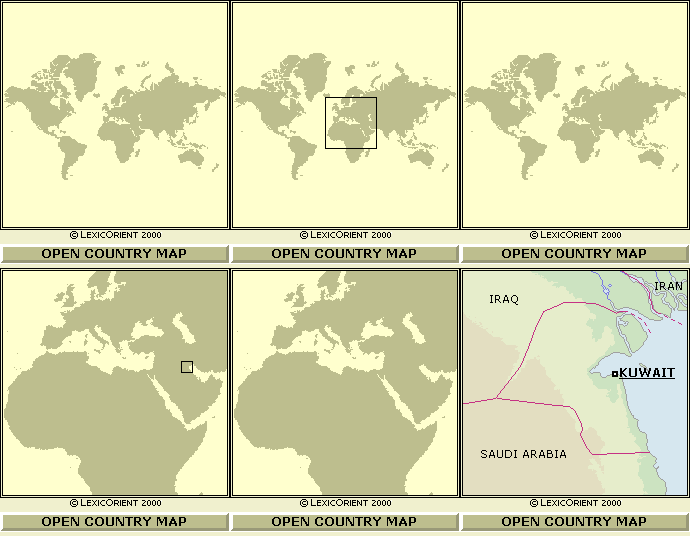
Border: 462 km . To Saudi Arabia 222 km; Iraq 240 km.
Coastline: 499 km.
Highest point: 306 m
Arable land: 0.3%
Kuwait is from nature's side all desert, made up of red soil, and there is little that favours agriculture.
Vegetation is limited to low bushes and scrub, and salt-loving plants in the marshes along the coast. There are a few tiny oases, and some sparse vegetation along the coast.
With the help of irrigation controlled by modern technology, Kuwait has come to be more green than before.
The landscape of Kuwait is flat, and the highest point in the country is 299 m. Kuwait has 9 islands, but only Faylaka is inhabited.
Average day temperature is 33°C, but can drop as low as -3° in January. 52°C is maximum temperature. Annual rainfall is between 25 mm and 175 mm, most of this falling during the months between October and March. Winter also comes with fierce dust storms, called kaus.
Life
Kuwait is on the Human Development Index ranked the best Arab country, no. 2 in the MENA, and 31 in the world. On a scale with 1.000 as maximum, Kuwait gains 0.916 points.
The currency of Kuwait is the dinar (KWD). It is a stable currency, and largely easily convertible into foreign currencies.
Kuwait has a strong economy from years of large oil revenues. The GDP per capita is at US$57,500 (2008 estimate), which is 450% above world average, and second highest among the MENA countries. Unemployment is very low at 2.2% and according to all indicators there are no inhabitants living below the poverty line.
Economy
Information about the health situation in Kuwait is confusing. No other MENA country has more obesity, Kuwait spends comparatively little on health care, yet life expectancy is among the highest.
Health
Although the United Nations rank Kuwait's education system quite unfavourably, Kuwait performs well on many factors, both with high literacy and good universities.
Education
Native Kuwaitis have Arab and Bedouin ancestry. Kuwait is the Arab country that denies a certain segment of its native population citizenship.
Peoples
Arabic is the daily language of Kuwait, English is also widely practiced. Some immigrant groups form small communities in which their original tongue is used.
Languages
Islam dominates in Kuwait, a majority of the Muslims are Sunni, but every third inhabitant is Shi'i. Immigrants usually belong to Islam or Christianity.
Religions
Good politics have secured that nationals today represent the majority of the population. Fertility rates have gone down in recent years, but population growth remains very high.
Demographics
Kuwait never was in the centre of world history until the 20th century, when the country emerged briefly as the richest country in the world, later it was in the headlines with the Gulf War.
History
|
|