Modern states /
Iran
Islamic republic of Iran Persian: jumhuriyya 'islamiyya 'īrān
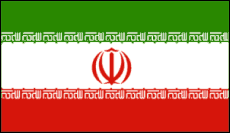
Independent republic in Asia with 72.4 million inhabitants (2009 estimate), covering a total area of 1,648,000 kmē and divided into 28 provinces. The capital of Iran is Teheran, situated in the north-central part of the country. Iran has democratic structures, but the politics of the country is rigidly controlled by the religious elite. Hence, the functions of a head of state is divided between the president and the Leader of the Islamic Revolution (Wali Faqih). The religious leader is Ayatollah Ali Hoseini-Khamenei, while Mahmoud Ahmadinejad has been president since 2005. National holiday is April 1, 1979, in remembrance of the proclamation of the Islamic republic. Political situation Provinces
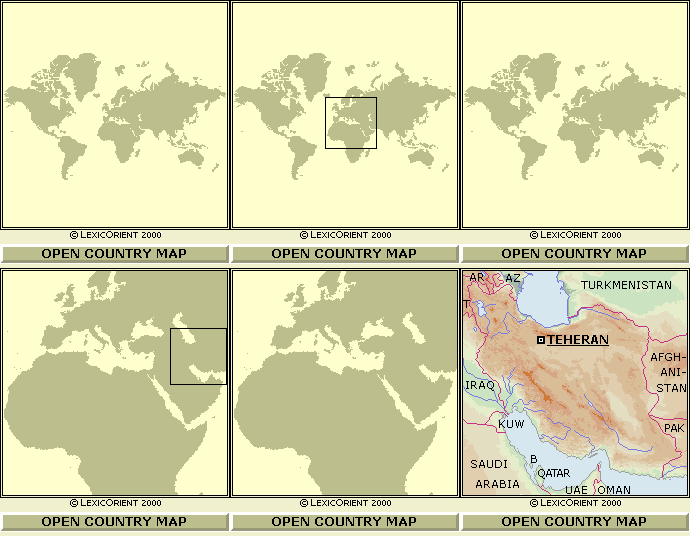
Geography Water surface: 12,000 km² Population density: 43.9 per kmē Borders: A total of 5,440 km. Of this, to Azerbaijan 611 km, Armenia 35 km, Turkey 499 km, Iraq 1,458 km, Pakistan 909 km, Afghanistan 936 km, Turkmenistan 992 km. Coastline: 2,440 km plus 740 km to the Caspian Sea. Highest point: Kuh-e Damavand 5,671 m Lowest point: Caspian Sea -28 m Arable land: 10.2%
Iran has a continental climate with forests in the north and the west. But desert dominates in the central regions, and semi-desert in the east and south. Iran is one of the most mountainous countries in the world, and all principal cities are at altitudes of 1,000 metres or more. This provides for a milder climate in summer, but results in snow in winter.
Life
Iran does not perform too well on the Human Development Index where it comes in as no. 88 of the 182 states that are ranked in the world. On a scale with 1 as maximum, Iran gains 0.782 points. Iran's GDP per capita is quite high at $12,800 (2008). Still, unemployment is quite high, at 13% and as many as 18% are below the poverty line. Economy
Iran's population growth rate is as low as 0.89%, indicating stability and fair control. Iran has a well-developed health care system, and life expectancy is almost 71 years. Health
Iran is among the countries putting most efforts into building a high-quality education system. The neglect of the past and the efforts of the present stand in contrast; Iran both has a high illiteracy rate and one of the highest student percetages in the MENA. Education
Iran is inhabited by a great number of ethnic groups, of which Persians and Azerbaijanis represent the largest. Peoples
Similar to the situation of ethnic groups, there are also a great number of languages spoken in Iran, but many are related. Persian is the largest language, and together with at least 17 other languages, it forms the group of Iranian languages, spoken by more than 70% of the total population. The other large group are Turkic languages, and a small minority speak Arabic. Languages
The situation of religions is less diversified, yet Iran is the home of 7 religions, of which Islam, mainly in its Shi'i form, dominates. Ahl-e Haqq, Alevism, Christianity and Baha'i have together more than 4 million adherents, whereas the indigenous religion of Iran, Zoroastrianism now only count a modest 60,000 followers in Iran. Religions
Iran is one of a growing number of MENA countries with fertility rates below 2.1 per woman. Today the population growth of Iran is low, and several indicators suggest that the population figures will stabilize within short time, and perhaps even begin to fall later this century. Demographics
The history of Iran is a proud one, Iranians have formed several empires and is one of the main culture peoples of the Middle East. Iran is to a great degree synonymous with Persia. History


 Political situation