|
|
Modern states /
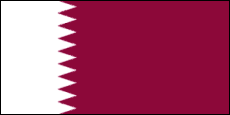
Qatar
State of Qatar
Arabic: dawlatu qatar 
Independent monarchy in Asia, divided into 9 municipalities (baladiya(t)) with 830,000 inhabitants (2005 estimate) and an area of 11,437 kmē. A census was carried out by March 1, 1997, counting 522,000 inhabitants.
The capital is Doha, which also forms the only effective urban centre of the country; second largest city, Rayyan, is largely a suburb of Doha.
The Day of independence for Qatar is September 3, 1971, when self-governance was gained from Britain. Independence was obtained peacefully and in good cooperation with the former protectors.
The Head of state is Emir Hamad bin Khalifa ath-Thani, cooperating with the Crown prince, Tamim bin Hamad bin Khalifa al-Thani and the Prime minister, Abdullah bin Khalifa al-Thani. There is a National Assembly, which has mainly advisory power, and which consists of 35 members.
 Political situation Political situation
Geography
Qatar has no permanent water surface; i.e. no rivers or lakes.
Population density: 71 inhabitants per kmē.
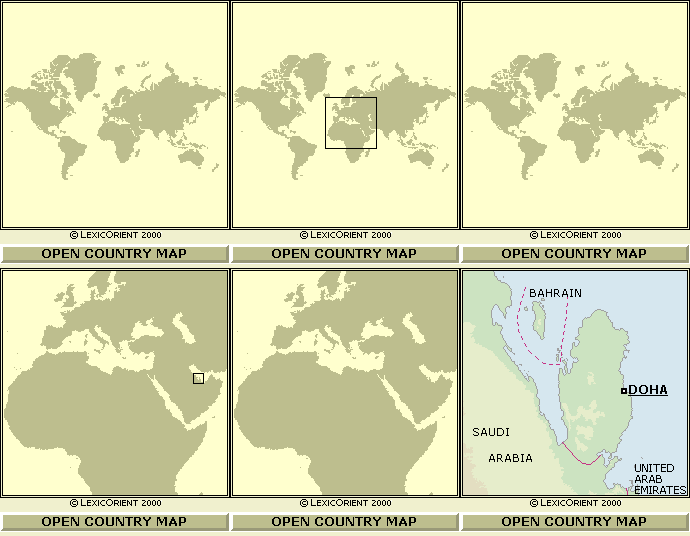
Border: 60 km and only to Saudi Arabia.
Coastline: 563 km.
Highest point: Qurayn Abu al-Bawl 103 m
Arable land: 1.3%
The peninsula of Qatar is mostly flat and stony arid land, while the desert in the south of the country is sandy. The highest point of Qatar is 83 metres above sea level.
Qatar has one of the harshest climates in the Persian Gulf. It is very dry, with an annual rainfall of less than 130 mm/year. Summers are long and hot with high humidity, while winters are pleasantly cool in daytime, but can be freezing at night.
Vegetation and wild life is extremely limited, due to climatic conditions. Most animals are small, and adjusted to desert living. Only the north has some vegetation.
Qatar borders Saudi Arabia and United Arab Emirates, while Bahrain's Hawar Islands is a few kilometres off the Qatari coast.
Qatar is strongly urbanized with 90% of the population living in towns and cities.
Life
Qatar is high among MENA countries on the Human Development Index, no. 33 in the world, and no. 3 in the MENA. Qatar scores on a scale with 1 as maximum, 0.910 points.
The currency of Qatar is rials (QAR) which has a fixed rate to the United States $ dollar.
Qatar is presently the world's richest country measured by GDP per capita; Qatar is here at an incredible 900% higher than world average, almost 5 times that of Saudi Arabia. Qatari economy appears well-managed, avoiding dangerous projects seen in some other oil rich countries in the region.
Economy
Qatar has one of the best health care systems in MENA; few countries has a higher frequency of internationally accredited hospitals.
Health
As of 2009, Qatar performs mediocre in terms of education. But efforts in recent years have been put into practice to change this radically. Qatar is clearly the strongest contender in this field in the MENA, and will most likely climb quickly in the years to come.
Education
Qatar is among the countries in the MENA with the higest number of foreign workers. As with other countries, foreign workers have no chance of obtaining citizenship.
Peoples
Arabic and English are the main languages of Qatar, while the foreign workers often form small communities for sparetime and small business where they use their native tongue.
Languages
Even with heavy immigration, Islam remains the main religion of Qatar. Christianity also has a strong presence.
Religions
No MENA country has had a stronger population growth in the 20th century than Qatar, perhaps in the whole world. Indigenous population continues to grow quickly; while the size of foreign communities can be controlled politically.
Demographics
Qatar has the shortest history of all MENA countries, many indicators suggest that it was uninhabited for centuries until the 16th century.
History
|
|