|
|
   United Arab Emirates / Cities and Towns / United Arab Emirates / Cities and Towns /
Al-Ain
Arabic: 'al-¢ayn
Other spellings: al-Ain, al-Ayn
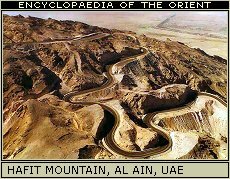
City in United Arab Emirates, located in the Buraymi Oasis, on the foot of Hafit Mountain. Al-Ain has 410,000 inhabitants (2005 estimate), the entire oasis about 480,000.
Al-Ain represents the oldest and most original settlement of the UAE, it is generally considered to be the cradle of the federation. Al-Ain comes from Arabic meaning "the eye", indicating its richness of water in this dry territory.
"Buraymi" may be used both as the name of the cluster of oases here, on both sides of the border between UAE and Oman, or simply as the name of the oasis town on the Omani side of the border.
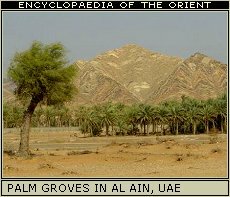
Al-Ain is fed by numerous wells, water which is still mainly used for agriculture. Most of the water is distributed by modern irrigation facilities, but the traditional system falaj is still in use some places. The falaj system uses a network of tunnels at its core, with open channels transporting the water further out.
The main produce of Al-Ain are fodder, vegetables, fruit and poultry. Modern achievements have allowed stock raising to become an important source of income. Also, reclamation projects have increased the agricultural area by 5 km². Al-Ain also has diverse industrial facilities, producing cement, cables, electric wire, sheet-metal, glass, ceramics and bricks.
Tourism has come to some importance to Al-Ain, both from the city, the oasis gardens, the surrounding mountains and the mineral springs. Despite having the highest summer temperatures in the country, Al-Ain is a popular summer retreat due to much lower humidity than the coast.
Al-Ain enjoys an excellent infrastructure with fast access to all other urban centres, as well as with Oman. The city also has an international airport.
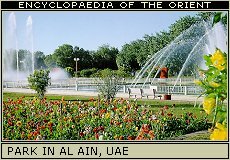
Al-Ain is the most traditionally-looking of UAE's cities, and is often referred to as "Garden City of the Persian Gulf," referring to the many parks and tree-lined avenues and roundabouts. Still sections of the city have houses made according to a traditional style, being made from dried earth.
Al-Ain has relatively fewer foreign inhabitants than any other large settlement in the country. Still the majority here are foreigners.
Al-Ain has a university (1976), as well as some other institutions for higher education.
History
The oldest traces of settlement at Al-Ain go back to 2700 BCE, with tombs containing stone statuettes.
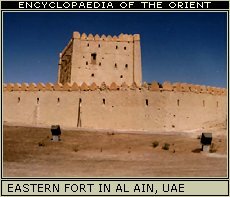
1910 CE: A fort is built outside the oasis by the command of Shaykh Ibn Zayd.
1952: Saudi Arabia occupies a neighbouring village in the Buraymi Oasis.
1953: In an agreement with Oman, Al-Ain becomes part of the Abu Dhabi Emirate.
1955: The Saudis are driven out of Buraymi by the troops of Abu Dhabi's sultan.
1974: An agreement is reached with Saudia Arbia securing Al-Ain as part of Abu Dhabi.
|
|